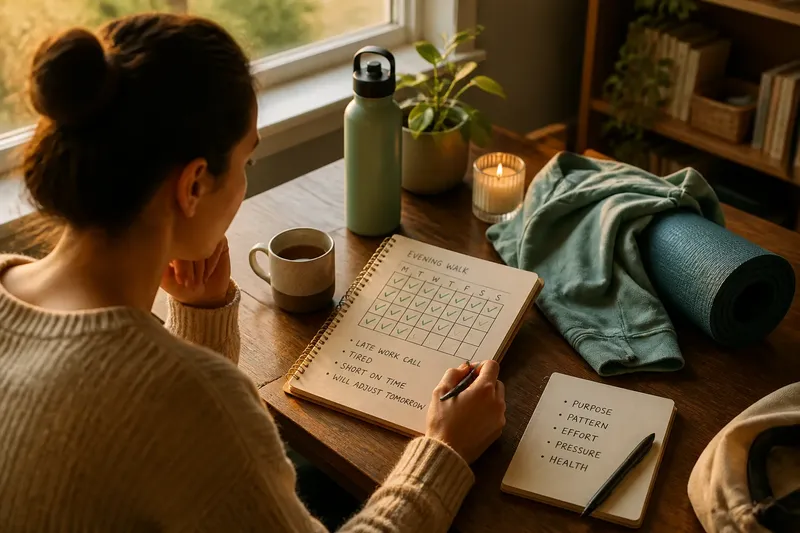
The Cue That Gives a New Routine a Place to Begin
Learn how to start a new routine by linking one modest action to a familiar daily cue, so it has a clear place in your day without adding complexity.

A new routine is easier to remember when it has a familiar cue: a moment that already happens, such as putting the kettle on or closing your laptop. To start a new routine, connect one small action to that cue, then make the action easy enough to do without reorganizing your day. The cue supplies the starting point; the modest action keeps the routine from becoming another demanding appointment.
Choose a real cue
Begin by noticing a moment that reliably occurs in your ordinary day. A useful cue is specific and observable, not a vague time of day. “After I put my lunch dishes in the sink” is clearer than “sometime after lunch.” A clock time can work if your schedule is steady, but a familiar event is often easier to recognize when the day shifts.
Look for moments that already have a clear beginning or ending: setting down your bag when you arrive home, washing your hands before lunch, or turning off a desk lamp at the end of work. The cue should be part of your existing routine, not a new task you must remember in order to remember the next task.
Choose a moment that leaves a little room for the action. If the cue happens while you are carrying groceries, crossing a busy street, or settling a child, it may not be a practical anchor. The point is not to seize every spare instant. It is to find a familiar transition at which the action can fit without causing a conflict.
Define the smallest action
Write the intended action in plain, observable terms. “Take care of myself” is too broad to begin. “Put a glass of water beside the coffee machine” or “open the notebook and write one line” gives you something you can recognize as done.
Keep the first version deliberately modest. If you want to stretch, choose one comfortable movement rather than a full sequence. If you want to read, open the book and read a short passage. A small beginning is not a claim that the larger aim does not matter; it is a way to give that aim a repeatable opening.
Say you want to write a few notes after dinner. Imagine that you already clear your plate to the counter each evening. You could set a notebook beside the counter after dinner, then write one sentence when you finish clearing your plate. The cue is finishing that familiar task, and the action has a clear endpoint. If you have time and interest, you can continue, but the routine’s first version does not depend on doing so.
Connect cue and action
Put the connection into one sentence: “After [familiar moment], I will [small action].” This is more useful than a general intention because it answers two practical questions: when to begin and what to do. Keep the cue and action close together in the sentence so the link is easy to recall.
Choose a cue that comes before the action, not one that happens only after it. If you want to prepare clothes for the morning, “after I finish getting dressed” points to the wrong part of the day. “After I put away my dinner plate” may fit better if that is a dependable evening moment and you have space to set something out.
Then make the action visible or easy to reach where that helps. Keep a notebook near the place you use it, or place a book on the chair where you plan to read. The cue does not need a special app, tracker, or reminder system. Extra tools can help if you already use them, but setting up a complex system is not worth the effort for a routine whose first action takes little time.
Check the fit
Before trying the routine, picture the cue as it actually happens. Ask whether you will notice it, whether the action can follow naturally, and whether anything commonly interrupts that moment. A routine may sound tidy in a plan but fail to fit the lived sequence of your morning or evening.
If the cue is easy to miss, make it more concrete. Replace “after I start my day” with “after I open the curtains.” If the action is awkward at that moment, choose a different cue rather than forcing it into place. If the action still feels too large, reduce it until the first version is simple to begin.
Keep the cue dependable, not perfect. A routine linked to a familiar event may still be missed when travel, illness, caregiving, or an unusual schedule changes the day. That does not mean the cue was poorly chosen. It means the routine needs a reasonable alternative for disrupted days, or a fresh start when the familiar moment returns.
Try the first version
Use the cue and action as written for a while, paying attention to what happens at the moment of transition. You do not need to keep score to learn whether the pairing fits. Notice whether the cue comes to mind, whether you have what you need, and whether the action feels manageable in its actual setting.
If you tend to forget, adjust the cue or make the needed object more visible. If you remember but regularly skip the action because it feels burdensome, make the action smaller. If the cue reliably occurs at an inconvenient time, choose another moment. Change one part at a time when possible, so you can tell which adjustment makes the routine easier to use.
For example, imagine that you plan to review a short list after closing your laptop, but you often leave the room immediately. You might move the list to the spot where you put your keys and link the action to picking up the keys before leaving. The observable result you are aiming for is a more noticeable prompt and a brief opportunity to review the list; if the new cue is still rushed, choose a calmer transition instead.
Make room for variation
A useful routine can have a small version for a crowded day and a fuller version for a day with more space. Keep the cue attached to the smallest version, so the routine still has a recognizable beginning. For instance, someone who hopes to plan meals might begin by writing down one item they need, then add more planning when it suits the day.
It is also fine to choose a different cue when life changes. A commute, work schedule, household arrangement, or season can alter which moments are dependable. Treat the cue as a practical choice, not a promise that your circumstances will stay fixed. If the old moment disappears, select a new familiar event and restate the connection in plain language.
A cue is not a test of discipline, and missing one is not a reason to compensate with an oversized effort. Return to the small action at the next suitable occurrence, or revise the pairing if the same obstacle keeps appearing. The aim is a usable place to begin, not a flawless record.
Questions about cues?
What makes a good routine cue?
A good cue is a familiar, noticeable event that usually happens before the action and leaves room for it. A specific transition, such as putting a cup in the sink, is easier to recognize than a broad intention like “later in the evening.”
Can I use a clock time instead?
Yes, if that time fits your actual schedule and is easy to notice. If your days vary, a recurring event may be more dependable than a time on the clock.
What if I forget the new action?
Make the cue more concrete or place the needed object where you will see it at that moment. If you remember but do not have room to act, choose a different cue or reduce the action.
Should I add more once the routine feels easy?
You can, but there is no need to expand it on a timetable. Keep the smallest version available, and add a little only when it fits your day without making the familiar cue harder to use.
When you revisit how to start a new routine, focus first on the moment that will bring it to mind. A clear cue and a modest action give the routine a place to begin, while leaving you free to adapt it when your day does not follow its usual pattern.